My AI Workflow Evolution: From Google Replacement to Multi-LLM Pipelines
I've been thinking about how my AI usage evolved over the last year.
In December 2024 I was basically using ChatGPT the way I used Google: I pasted info and asked for an explanation, or asked it to find and compare information.
Then a friend gave me a simple push: "Stop thinking about AI. Focus on your practical tasks and use AI whenever you are stuck." That changed everything. I finished December 2025 with much more hands-on experience and honestly, real enthusiasm.
The 6 Levels of AI Usage
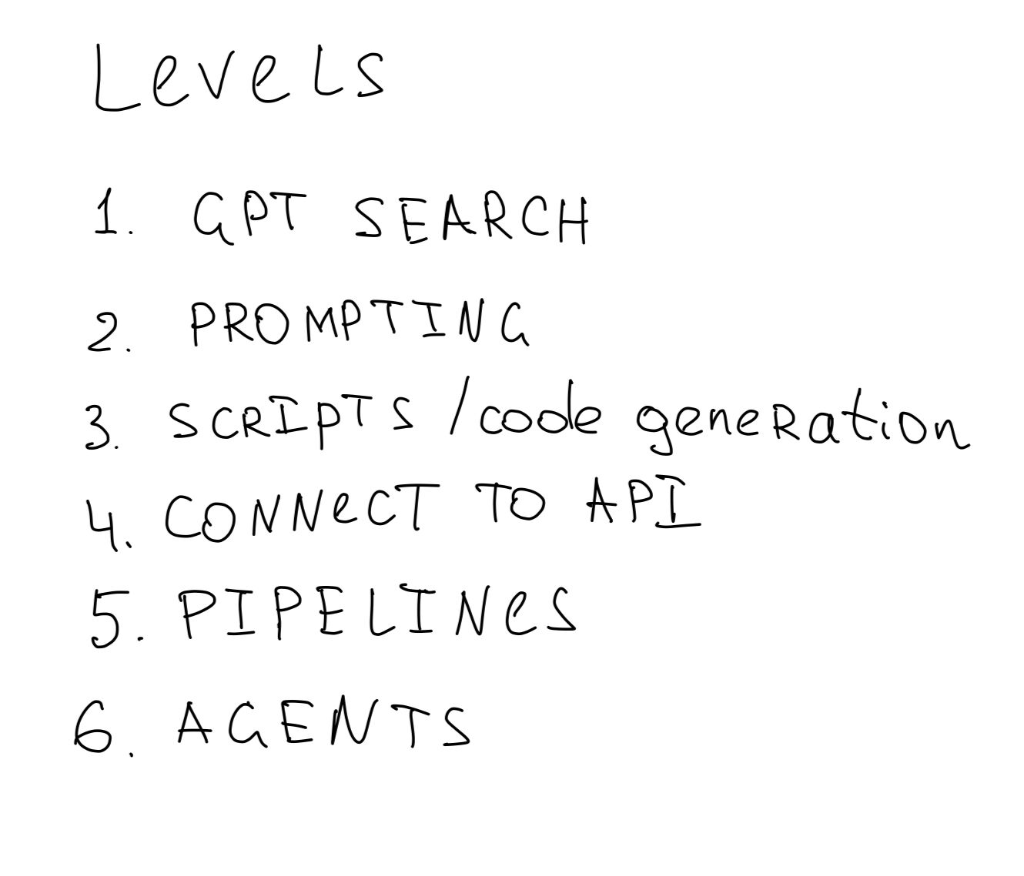
Since I'm a structured person, I tried to map the levels I've seen in myself and in friends. Maybe it helps someone who also feels stuck. Each level gives more valuable outcomes from AI.
Level 1: AI as Google
You paste a question, get an answer. Simple search queries, quick explanations. This is where most people start — and where many stay.
Typical use: "What does this error mean?" or "Compare X and Y."
Level 2: Outcome-Driven Prompts
You stop asking vague questions and start writing prompts with clear context, constraints, and desired output format. You discover Projects/Custom GPTs and start organizing your workflows.
The shift: from "Tell me about X" to "As a product manager preparing a stakeholder presentation, create a 5-slide outline covering..."
Level 3: Python Scripts for Automation
You start writing small scripts — often with AI's help — to automate tasks at scale. Processing spreadsheets, batch-renaming files, parsing data. The magic moment: realizing AI can write code for you.
The shift: from manual one-at-a-time tasks to "let me automate this in 20 minutes and save hours every week."
Level 4: API Connections
You move beyond chat interfaces. Connecting directly to OpenAI, Anthropic, or Gemini APIs. Building custom tools that fit your workflow exactly, not what a chat UI allows.
The shift: from consumer to builder. You control the model, the prompts, the output format.
Level 5: Multi-LLM Pipelines ← I'm here
You chain multiple models together. One extracts data, another validates, a third generates the final output. You pick the right model for each task. Orchestration becomes the skill.
The shift: from "which model is best?" to "which combination of models solves this problem most reliably?"
Level 6: Autonomous Agents
AI systems that plan, execute, and iterate independently. They break down complex goals, use tools, handle errors, and deliver results with minimal human oversight.
The shift: from directing AI to supervising it.
The Key Insight
The jump between levels isn't about intelligence or technical skill. It's about shifting your mindset from "AI is a tool I use" to "AI is a collaborator I work with."
Each level compounds. Once you automate one workflow, you see automation opportunities everywhere. Once you connect an API, chat interfaces feel limiting. Once you build a pipeline, single-model solutions feel incomplete.
My Advice
If you feel stuck at any level, remember my friend's advice: stop thinking about AI and focus on your tasks. The next level will come naturally when your current approach starts feeling insufficient.
I write about building AI products. Follow on LinkedIn. Building something similar? Book a call.
← Blog